KDP Publishers Workbook: Your Operational Dashboard for Self-Publishing Success
Managing a self-publishing business on Amazon KDP means juggling multiple projects, tracking performance across dozens of listings, and making decisions that directly impact your bottom line. Without a structured system, it's easy to lose sight of deadlines, miss optimization opportunities, or let promising book ideas stall. The KDP Publishers Workbook addresses this directly: it provides a single, organized framework to plan your publishing strategy, track performance, and scale your author business methodically.
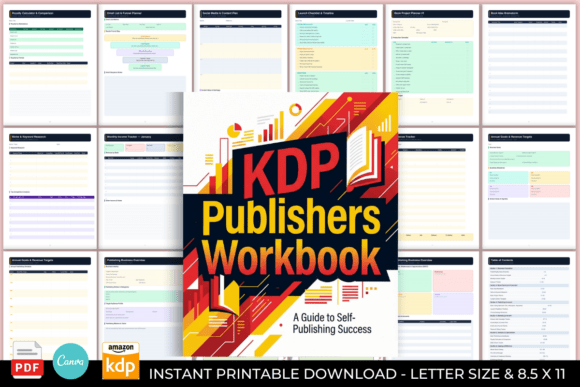
Rather than being another generic planner, this workbook functions as an operational dashboard. It combines business foundation, goal tracking, book production checklists, and performance analysis into one resource. Whether you publish low-content notebooks, medium-content journals, or full-length manuscripts, the workbook helps you manage every stage—from idea generation through launch and ongoing optimization.
Below, we'll walk through how to integrate this workbook into your actual workflow, what each component offers in practice, and how it interacts with the tools and decisions you already make.
What the KDP Publishers Workbook Is and Where It Fits
At its core, the KDP Publishers Workbook is a structured system designed to bring order to the self-publishing process. It's not a one-time resource; it's something you use before, during, and after each project. Think of it as the central hub where your business strategy, project plans, and performance data converge.
Where it fits in your broader process:
- Before a project: Use the niche research and book idea worksheets to validate concepts before you invest time in writing or design.
- During production: Follow the content outline templates and production checklists to stay on track and avoid last-minute scrambles.
- After launch: Monitor monthly income, track ad performance, and analyze profit insights to refine your approach for the next book.
The workbook interacts naturally with other tools you already use: Amazon KDP reports, keyword research tools (like Helium 10 or Publisher Rocket), spreadsheet budgets, and even your calendar for scheduling. It doesn't replace those—it organizes them into one actionable flow.
Building a Foundation: Business Strategy and Brand Identity
Before you publish anything, you need clarity on who you're serving and what differentiates your brand. The workbook includes sections for a publishing business overview, brand identity mission, target audience profiles, niches and categories, and a SWOT analysis. This isn't abstract theory; it's practical groundwork that saves time later.
For example, defining your target audience profile early helps you make faster decisions about cover design, interior formatting, and keyword selection. When you know exactly who will buy your low-content journals, you can tailor your listing copy and ad targeting more precisely. The SWOT analysis also highlights risks—like seasonality in a niche—so you can plan accordingly.
Implementation tip: Complete the business foundation pages once, then revisit them quarterly. As your audience evolves or you enter new categories, update your profiles and SWOT. This keeps your strategy aligned with real market conditions.
Goal Setting and Financial Tracking
Revenue targets are meaningless without a system to track progress. The workbook includes annual revenue targets, quarterly milestones, monthly income trackers (January through December), expense tracking, and profit insights. This section is where you turn ambition into numbers you can monitor.
Here's how to use it in practice:
- Set annual targets based on your previous year's performance or a realistic estimate for a new publisher. Break that into quarterly milestones.
- Record monthly income from KDP royalties, plus any other channels if you're expanding. The monthly trackers make it easy to spot trends—like a dip in summer or a spike in Q4.
- Log expenses: editing, cover design, ad spend, ISBNs, formatting software. Seeing these alongside revenue gives you a clear profit picture, not just a top-line number.
- Use profit insights to decide which niches or book types are worth more investment and which are dragging you down.
This financial tracking section interacts with your book planning worksheets. If a specific project is underperforming, you can quickly see whether the issue is low sales, high ad costs, or seasonal slump. Then you can decide: optimize the listing, pause ads, or move on to a new idea.
Book Planning and Production: From Idea to Checklist
This is where the workbook becomes a project management tool. The book planning section includes idea brainstorm pages, niche and keyword research worksheets, book project planners, content outline templates, and production checklists. Each element serves a specific purpose in your workflow.
Niche and keyword research worksheets are critical. Before you write a word, you research search volume, competition, and trending topics. The worksheet forces you to document the keywords that will drive your listing's discoverability. Later, when you create your product description and backend keywords, you refer back to this research. This ties directly into your ad campaigns—you can use the same keywords for Amazon PPC.
The book project planners are where you assign tasks, deadlines, and owners (if you have a team). For a solo publisher, this means blocking out time for writing, formatting, cover creation, and review. The production checklist ensures nothing is missed: proofreading, ISBN assignment, category selection, pricing, and more.
Workflow example: You brainstorm ten book ideas on the idea brainstorm page. You narrow it down to two based on the niche research worksheet. For the chosen idea, you create a content outline using the template. You set deadlines in the project planner and work through the production checklist. When the manuscript is ready, you move to listing optimization—using the keywords you already documented.
Listing Optimization and Launch Execution
A great book won't sell if nobody finds it. The workbook addresses this with sections dedicated to improving listings through keyword and niche research. While the exact launch checklist isn't spelled out in the limited preview, the workbook's broader structure implies you'll use the research data to optimize titles, subtitles, bullet points, and description.
Here's how to integrate this into your routine:
- Before you upload: Use the keyword research worksheet to identify the top 5–7 search terms for your niche. Incorporate them naturally into your title, subtitle, and bullet points.
- During launch: Run a low-budget PPC campaign using the same keywords. Monitor performance in the ads tracking section (if included) and adjust bids based on ACoS.
- Post-launch: Review listing analytics in KDP Reports. If a listing underperforms, revisit your keyword research and consider A/B testing your main image.
The workbook helps you stay disciplined here. Many publishers skip keyword research or do it once and forget it. With structured worksheets, you're more likely to treat optimization as an ongoing process, not a one-time task.
Managing Multiple Projects and Staying Consistent
Consistency is a superpower in self-publishing. Readers and Amazon's algorithm both reward publishers who release regularly. The workbook includes scheduling tools to help you plan your publishing cadence. Whether you release one book per month or one per quarter, you can map out your timeline across multiple projects.
For example, you might have a low-content journal in the design phase, a medium-content planner in the formatting stage, and a full-length manuscript being written. The workbook's project planners let you track each simultaneously, so you don't overcommit or miss a launch date.
Practical observation: New publishers often underestimate how long production takes. Using the checklist and project planner early forces you to estimate realistically. Over time, you'll build a data set of how long each type of book actually takes—from idea to published—and can plan future projects more accurately.
Long-Term Optimization and Scaling
The final piece of the workbook focuses on making data-driven decisions to grow revenue. This goes beyond launch tracking. It's about analyzing which categories, formats, and price points are working, and then doubling down on what's effective.
Here's how you'd use the workbook for scaling:
- Audit your catalog quarterly: Use the monthly income and profit tracking to identify your top 20% of books (by revenue). Ask: What do they have in common? A specific niche? A particular cover style? A certain price point?
- Reallocate resources: If low-content books are your top performers, focus more time on that format. If full manuscripts aren't selling, pause them until you understand why.
- Expand to new niches: Use the niche research worksheets to find adjacent categories with demand but lower competition. Test with one book before committing to a series.
The workbook also supports experimentation. You can track the performance of ad campaigns, monitor the impact of listing tweaks, and compare results across months. This turns publishing from guesswork into an iterative process.
Practical Implementation Tips
To get the most out of the KDP Publishers Workbook, consider these approaches based on real workflow integration:
- Start small. You don't need to fill every worksheet on day one. Begin with the target audience profile and one book project planner. Add the financial tracking after your first launch.
- Use it alongside KDP Reports. The workbook is where you summarize and interpret data; KDP Reports provides the raw numbers. Together, they give you a complete picture.
- Review monthly. Set a recurring 30-minute meeting with yourself to update income, check expenses, and review project status. This keeps the workbook alive, not just a document you fill once.
- Combine with a calendar. Use the project planner deadlines to populate your calendar with specific tasks: "Write chapter 3," "Review cover proofs," "Launch PPC campaign." This bridges planning and action.
- Keep it digital or print. If you prefer digital, use a PDF annotation tool or import into Notion. If you like paper, print the worksheets for each project. The key is to make it a working document, not a static file.
Observations on Usability and Long-Term Fit
The workbook's strength lies in its comprehensive structure. It covers business foundation, goals, book planning, and financial tracking in one place. For a solo publisher, this eliminates the need to juggle multiple spreadsheets and notebooks. For a small team, it serves as a shared reference point for roles and timelines.
One nuance: the workbook is most effective when you treat it as a living resource. If you fill it out once and never revisit, you'll miss the feedback loop that drives improvement. The real value comes from updating it as you launch, tracking results, and adjusting your strategy based on what the numbers tell you.
Another factor: the workbook doesn't replace specialized tools like keyword research software or ad management platforms. Instead, it helps you organize the output from those tools into actionable plans. You'll still use Helium 10 for keyword data, but the workbook ensures you apply that data consistently across your projects.
Final Thoughts on Integrating the Workbook
The KDP Publishers Workbook is not a quick fix—it's a system for building a sustainable publishing business. It fits naturally into the workflow of anyone who wants to move from publishing sporadically to publishing with intention. By combining strategy, planning, tracking, and analysis in one place, it reduces the cognitive overhead of managing multiple projects and helps you make decisions based on evidence rather than instinct.
Whether you're a new author testing your first low-content journal or an experienced publisher scaling a catalog of full manuscripts, this workbook gives you a structure to stay organized, consistent, and profitable. Start with one section, integrate it into your weekly routine, and watch how clarity replaces chaos as you build your author business.