1000 Digital Product AI Prompt Book
Starting from a blank page is one of the hardest parts of building digital products. You know you want to create something valuable, but the sheer range of possibilities can stall momentum. The 1000 Digital Product AI Prompt Book is built to remove that friction entirely. It’s a structured collection of ready-to-use prompts that guide you from the first spark of an idea all the way to a monetized, audience-ready product. Whether you are a creator, a founder, or a designer, this book gives you a repeatable process for generating and validating profitable ideas without the guesswork.
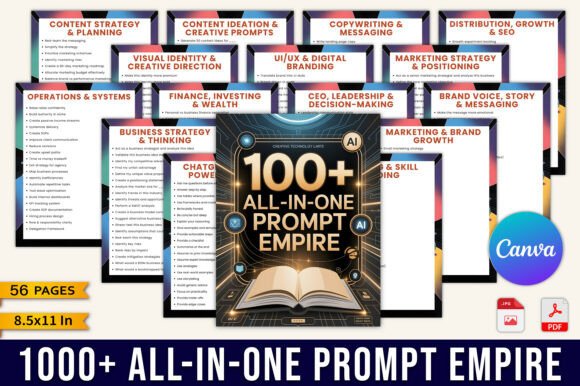
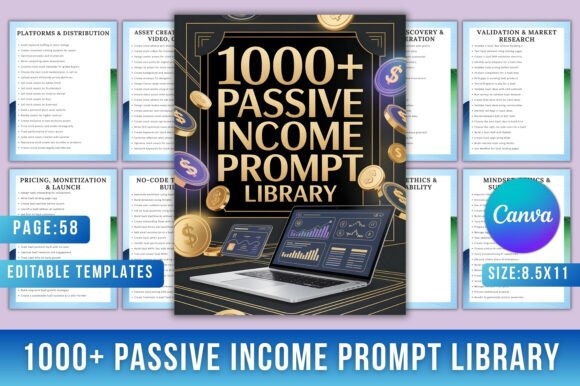
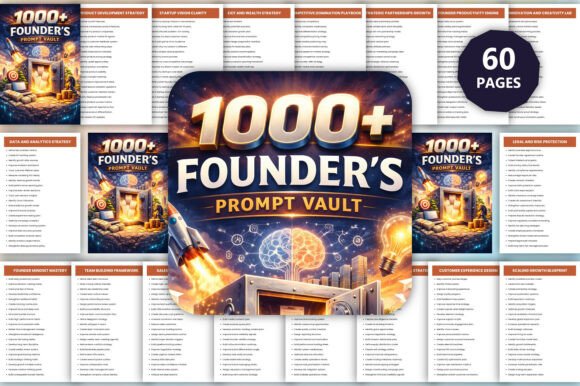
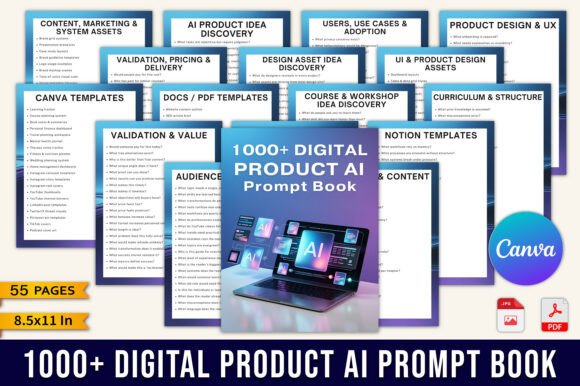
What makes this resource genuinely useful is that it does not just dump a list of prompts on you. It organizes them into a framework that mirrors how real digital products get built. You get prompts for idea discovery, market validation, branding, template creation, and monetization. Each stage builds on the last, so you can move from “what if” to “this works” with clarity and speed. The book includes 55 different Canva templates, an editable Canva link, and high-quality PDF files ready to upload. Page size is standard 8.5×11 inches, making it easy to print or reference on screen.
Below, we explore how different users can adapt this prompt book for their specific goals, what creative possibilities it opens up, and how to get the most out of every section.
A Framework That Mirrors Real Product Development
Most prompt collections are lists of questions. This book is different because it groups prompts into stages that reflect how successful digital products actually get built. You start with idea discovery, move into validation, then shift into branding and templates, and finally tackle monetization. Each stage contains prompts that build on the previous one, so your thinking becomes progressively more concrete and actionable.
For a designer, this means you can use the branding prompts to clarify visual direction before you open any design software. For a founder, the validation prompts help you test assumptions before investing time in development. For a content creator, the monetization section gives you language and positioning strategies that convert visitors into buyers. The framework is not rigid—you can jump between stages depending on where you are in a project. But having a clear structure prevents the scattered, unfocused thinking that often derails product creation.
Idea Discovery and Validation: Moving Beyond Surface-Level Concepts
The idea discovery prompts in this book are designed to push you past generic concepts like “a productivity planner” or “a recipe ebook.” They ask questions about audience pain points, overlooked niches, and personal expertise that can be turned into a product. For example, one prompt might ask you to list three recurring questions from your audience and then transform each into a product concept. Another might guide you to identify a common frustration in your industry and design a template that solves it.
Validation is where many creators get stuck. You might have a strong idea but no real evidence that people will pay for it. The validation prompts help you design simple tests, craft survey questions that reveal true demand, and analyze competitor gaps. A practical example: you can use a prompt to draft a landing page teaser for a digital product idea, then share it with a small segment of your audience to gauge interest. The book gives you the exact language to ask for feedback without sounding like you are selling too early.
For a small business owner, validation can mean testing a new service package before building the full offer. For a freelancer, it can mean checking whether clients actually need the template system you are considering. The prompts make validation a lightweight, quick step rather than a months-long research project.
Branding and Templates: Creating Consistent, Professional Assets
Once you have a validated idea, the next challenge is making it look credible and cohesive. The branding prompts in the 1000 Digital Product AI Prompt Book help you define your product’s tone, color direction, typography choices, and messaging pillars. You can use them to write a brand brief that you hand to a designer, or to create your own visual guidelines if you work solo. The prompts are specific enough to produce usable output but flexible enough to adapt to any niche.
The template section is where the book really shines for practical application. With 55 Canva templates included, you have a starting point for planners, worksheets, journals, checklists, trackers, and other common digital product formats. You are not limited to those templates—they serve as a foundation you can customize. The prompts guide you on how to modify layouts, adjust content blocks, and tailor the design to your audience. For instance, a prompt might ask you to identify which template style best matches your audience’s learning preference (visual, structured, or freeform) and then suggest specific layout changes.
If you are a publisher or educator, you can use these templates to create workbooks, lesson plans, or course supplements. If you are a blogger or content creator, you can repurpose them into lead magnets, opt-in freebies, or content upgrades. The key is that you are not starting from a blank page—you are starting from a professionally designed foundation and then making it your own.
Monetization Strategies That Go Beyond “Set a Price”
Pricing a digital product is rarely straightforward. The monetization prompts in this book help you think about positioning, perceived value, pricing tiers, and upsell opportunities. One prompt might guide you to create a free version, a standard version, and a premium version of a single product, with clear distinctions between each tier. Another prompt helps you write sales copy that highlights the transformation your product delivers, not just its features.
For a creator on a platform like Gumroad or Etsy, the prompts can help you optimize your product description, choose the right pricing model (one-time vs. subscription), and craft a launch sequence. For a designer selling templates, the prompts can help you bundle related products together or create recurring revenue through a membership model. The monetization section is not about aggressive sales tactics. It is about aligning price with value and making it easy for the right buyer to say yes.
Adapting the Book for Different Audiences and Goals
The 1000 Digital Product AI Prompt Book is designed to be adaptable across use cases. Here is how different users can tailor it to their context:
- Freelancers: Use the validation prompts to test new service packages before offering them to clients. Repurpose the branding prompts to build your own portfolio templates.
- Educators and course creators: Turn the template section into lesson handouts, student workbooks, or course supplements. The monetization prompts help you price and bundle educational products.
- Small business owners: Use the idea discovery prompts to identify digital products that complement your physical offerings. For example, a coffee roaster could create a brewing guide journal or a tasting notes template.
- Marketers and bloggers: Adapt the template prompts to create lead magnets that capture email subscribers. The validation prompts help you test which freebie resonates most with your audience.
- Hobbyists and side hustlers: Use the prompts to turn a personal passion into a sellable product without overcomplicating the process. The structured framework keeps you moving forward even when motivation dips.
Because the prompts are text-based and format-agnostic, you can apply them to any digital product type—ebooks, planners, presets, printables, templates, guides, checklists, and more. The same prompt that helps a designer create a brand kit can help a writer outline a workbook. The flexibility comes from the prompts focusing on questions and frameworks rather than rigid instructions.
Keeping Results Organized and Audience-Friendly
A common pitfall with using AI prompts is ending up with scattered ideas that never get assembled into a finished product. The prompt book addresses this by grouping prompts into stages that produce outputs you can immediately use in the next stage. For example, the idea discovery prompts generate product concepts that feed directly into the validation prompts. The validation prompts produce feedback data that informs your branding decisions. Each stage produces a tangible artifact—a list, a brief, a draft, or a design—that you can store in a folder and reference later.
To keep results clear and consistent, consider creating a simple folder structure on your computer or in your cloud storage. Label folders by stage (Idea Discovery, Validation, Branding, Templates, Monetization) and save outputs as you go. If you use the editable Canva link, organize your templates into subfolders by product type or audience. This habit prevents the chaos of having dozens of ideas with no home and makes it easy to pick up a project weeks later without losing context.
For audience consistency, use the branding prompts early to define a tone and visual style, then apply that style to every template you create. This way, even if you produce multiple products, they feel like they belong together. Your audience will recognize the look and feel, which builds trust over time.
Realistic Examples of How the Prompts Play Out
Let’s look at two concrete scenarios to see how the book works in practice.
- Scenario 1: A blogger wants to create a productivity planner. Using the idea discovery prompts, they identify that their audience struggles with morning routines, not general productivity. They validate this by asking a few email subscribers directly. The branding prompts help them choose a clean, minimal aesthetic with warm accents. They use one of the Canva template layouts for a weekly planner and customize the sections to focus on morning habits. The monetization prompts guide them to offer a free one-page version and a full 30-day version for purchase. Within a week, they have a product that is grounded in audience feedback and ready to launch.
- Scenario 2: A freelance designer wants to sell social media template packs. The idea discovery prompts help them narrow down to Instagram Story templates for a specific niche—interior design businesses. They validate by reaching out to three interior design clients and asking what formats they need most. The branding prompts help them create a consistent visual style across all templates. They customize one of the Canva templates to produce five Story templates, then use the monetization prompts to write copy that highlights time saved and brand consistency. They price it as a mid-range offer and include a bonus checklist of post ideas. The whole cycle takes less than two weeks.
These examples show that the prompts are not abstract. They produce real, usable results in a short time frame. The key is to trust the process and not skip the validation stage, even if you feel confident in your idea.
Getting the Most Out of the Book
To truly benefit from the 1000 Digital Product AI Prompt Book, approach it as a workbook rather than a reference. Set aside dedicated time for each stage, even if it is just 20 minutes. Write down your answers to the prompts instead of thinking through them mentally. The act of typing or writing forces clarity and makes it easier to spot weak points in your thinking.
If you are working on multiple product ideas, use separate documents or folders for each one. This prevents cross-contamination of ideas and keeps each product’s journey clear. Revisit the validation prompts periodically—what your audience needed six months ago may have changed. The prompts are not a one-time tool; they are a system you can return to for every new product you develop.
Finally, resist the urge to overcomplicate the templates. The 55 Canva templates are designed to be clean and professional. Focus on content and audience fit before adding elaborate design flourishes. A simple, well-targeted product consistently outperforms a visually ornate product that does not meet a real need. Use the prompts to clarify the content, then let the templates handle the visual structure.
The 1000 Digital Product AI Prompt Book is not another list of generic ideas. It is a practical toolkit for moving from concept to cash with less friction and more confidence. Whether you are launching your first digital product or scaling a portfolio, the structured prompts give you a reliable process that removes the blank page problem for good.