The E-Book Empire Blueprint: A Practical Guide for Digital Creators
If you have ever found yourself staring at a blank screen, wondering whether your ideas could actually become something people would pay for, you are not alone. That moment of hesitation is exactly where most aspiring digital creators get stuck. The E-Book Empire Blueprint was designed with that exact scenario in mind. It is not a theoretical course filled with jargon or a sales page dressed up as a guide. It is a straightforward, 20-page framework that walks you through turning a concept into a finished e-book, ready for marketplaces like KDP or your own storefront.
What makes it feel different from the usual “how to write an e-book” advice is the focus on the practical steps that happen before you even open a document. It assumes you might be starting from zero, and it meets you there. Whether you are a teacher with lesson notes to organize, a freelancer wanting to package your process, or a hobbyist who has been told your niche knowledge could sell, the blueprint offers a structure that reduces the overwhelm of starting something new.
Who tends to pick this up and why
The people who reach for The E-Book Empire Blueprint often share a few common traits, but their backgrounds vary widely. Take someone working a full-time job in retail or administration, for example. They may have a side interest in meal planning, budgeting, or urban gardening. They know their topic well, but they have no idea how to turn that knowledge into a digital product. The blueprint appeals to them because it does not demand prior experience with design software, formatting rules, or marketing funnels. It just shows a clear path from idea to a finished file.
Another typical user is the creator who has already tried selling physical products and found the logistics exhausting. They understand the basics of selling but want something lighter to manage. E-books appeal to them because there is no inventory, no shipping, and no returns. The E-Book Empire Blueprint helps them see how digital products fit into their existing workflow without requiring them to learn a whole new business model from scratch.
Then there is the aspiring entrepreneur who loves learning but struggles with follow-through. They have bought courses, downloaded templates, and filled notebooks with ideas. What they need is something that holds their hand just enough to produce a finished product. The blueprint’s 20-page length is intentional here. It is short enough to read in one sitting but structured enough to act as a checklist you can return to at each stage of your project.
Even experienced writers sometimes find themselves unsure about formatting for digital platforms or deciding on page size and file types. The guide includes practical specifications like 6 × 9 inch page size and explains why certain formats work better for different platforms. For someone who has written content but never published it as a digital product, that kind of detail saves hours of trial and error.
Real-world scenarios where the blueprint fits naturally
Imagine you are a yoga instructor who has been teaching the same sequence of poses for years. Your students keep asking for a written reference they can use at home. You could film a video or create a PDF, but you are not sure what format people actually want or how to price it. The E-Book Empire Blueprint walks through exactly that kind of situation. It helps you think about what your audience expects, how to structure content so it feels valuable, and what file types to prepare so it looks professional whether someone reads it on a tablet or prints it at home.
Consider a freelance graphic designer who wants to create a portfolio guide or a “how to work with a designer” handout for clients. They already have the visual skills, but they may not know how to structure a digital product around their expertise. The blueprint provides a reusable framework that takes the guesswork out of organizing content. Instead of inventing a structure from scratch, they can follow the guide, adapt it to their voice, and have something ready to share within a week.
Another scenario involves a parent who has developed a system for organizing family schedules and wants to share it with other busy families. They are not a professional writer or designer, but they have a real solution to a common problem. The E-Book Empire Blueprint appeals to them because it does not assume they have a platform or a following. It focuses on the product itself, helping them create something clean and useful that they can then share in small communities, parenting groups, or on a simple landing page.
For someone in a corporate role who writes reports and presentations regularly, the idea of writing an e-book might feel surprisingly familiar. The difference is that corporate documents follow rigid formats, while a personal e-book gives them creative freedom. The blueprint helps bridge that gap by offering a minimalist, professional layout that feels familiar to someone used to clean reports but allows for a more personal voice.
How different users get different value from the same guide
One of the strengths of The E-Book Empire Blueprint is that it does not prescribe a single way to use it. A person focused on passive income might follow it strictly, producing an e-book in a weekend and listing it on KDP within days. Another person might use it more loosely, pulling out the sections on formatting and design while writing their content in their own time. The guide works as a framework, not a rigid script.
For someone who values speed, the ready-to-use structure is a major advantage. They do not need to wonder what comes first or second. The steps are laid out in a logical order, and the clean design means they do not have to spend hours tweaking fonts or margins. For someone who values depth, the 20 pages offer just enough explanation without drowning them in theory. It is possible to read through it once, get the big picture, and then refer back to specific sections as needed.
The beginner-friendly mindset is another element that plays out differently depending on the user. A complete beginner might appreciate the reassurance that they do not need expensive tools or a huge audience. A more experienced creator might use the blueprint to streamline their existing process, cutting out steps that were slowing them down. Both groups benefit, but in different ways.
Practical considerations before you start
One thing to keep in mind is that The E-Book Empire Blueprint is a guide to the process, not a content generator. You still need to bring your own topic, knowledge, and voice. If you are hoping for a fill-in-the-blank template that writes the e-book for you, that is not what this is. What it offers is clarity on the stages and specifications so you can focus your energy on the content itself.
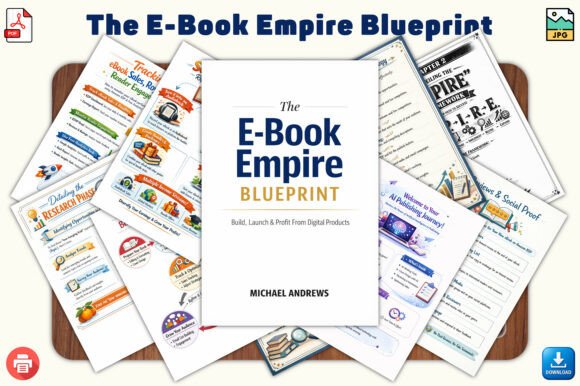
The guide is also intentionally minimal in its design. For some, that is exactly what they want, a clean, distraction-free layout that lets them concentrate on the work. For others who prefer more visual examples, screenshots, or case studies, the simplicity might feel a bit sparse. The design choices align with the “white background, clean modern layout” description, which works well for reading but does not include decorative elements or extensive illustrations.
Another consideration is the target audience for your e-book. The blueprint covers the mechanics of creating and launching a digital product, but it assumes you have at least a rough idea of who you are writing for. If you are still unsure about your niche or your reader, you may want to spend some time clarifying that before diving into the production steps. The guide can help you structure what you know, but it does not replace the upfront work of understanding your audience.
For those planning to sell on KDP or similar marketplaces, the included JPG and PDF formats are directly useful. The print-ready JPG files are especially handy if you want to offer a version that buyers can print at home or take to a local print shop. The 6 × 9 inch page size is a common trade paperback dimension, which means your e-book will look familiar and professional in both digital and print formats.
Strengths that stand out in daily use
The reusable framework is probably the most practical feature for anyone who plans to create more than one e-book. Once you have gone through the process with the first project, the second one becomes faster because you already understand the workflow. The guide essentially teaches you a repeatable system, which is valuable if you see digital products as an ongoing source of income rather than a one-time experiment.
The clarity around page size and format is another strength that saves time. Many beginners waste hours researching whether their file will look right on different devices or whether they need separate files for print and digital. The E-Book Empire Blueprint answers those questions directly, so you can move past the technical doubts and focus on writing and designing.
The tone of the guide also matters. It is written for someone who may be skeptical of their own ability to produce a digital product. The language is encouraging without being pushy, and the steps are broken down in a way that feels achievable. That matters for the 20-to-50 age range, where many people have responsibilities and limited time but still want to explore creative or entrepreneurial projects.
Where it fits into a larger digital product strategy
For someone building a passive income stream, this blueprint can serve as a foundation. Once you have one e-book published, you might use the same framework to create a series or to expand into related topics. The guide is not tied to any particular niche, so it works equally well for how-to guides, recipe collections, workbooks, planners, or short reference materials.
If you are already selling other digital products like templates or printables, adding an e-book can diversify your offerings. The blueprint helps you see how an e-book fits into the same workflow you already use for your other products. The file formats and design principles overlap, making it a natural extension of what you already do.
And for someone who simply wants to share their knowledge without worrying about the business side, the guide still works. You do not have to sell your e-book. You can give it away as a lead magnet, use it to build an email list, or share it with a community. The production process remains the same, and having a finished product gives you something tangible to offer, whether or not money changes hands.
The E-Book Empire Blueprint is not about promising overnight success or unrealistic income claims. It is a practical, no-fluff resource for anyone who has something to say and wants to say it in a format that people can read, share, and value. Whether you are testing the waters of digital publishing or looking for a repeatable system to scale your efforts, it gives you a clear starting point without the noise.