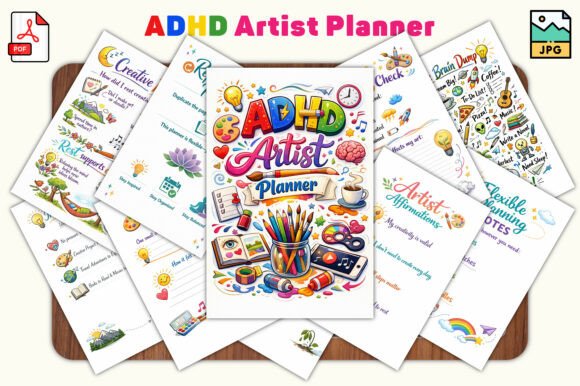
ADHD Artist Planner: Gentle Creative Support
If you are a creative person living with ADHD, you have likely tried multiple planning systems that promised structure but delivered frustration. Rigid daily schedules, habit trackers, and productivity streaks rarely work for an artistic brain that thrives on spontaneity, hyperfocus, and emotional connection to projects. The ADHD Artist Planner was created specifically to address this mismatch. Instead of forcing you into a one-size-fits-all productivity mold, it offers a flexible framework that adapts to how your mind actually functions. This article explores what makes this planner different, how it can support your creative practice, and whether it might be a good fit for your workflow.
Why Traditional Planners Often Fail Creative ADHD Brains
Most planners assume a linear, predictable creative process. They expect you to work the same amount each day, break tasks into neat hourly blocks, and maintain consistent motivation. For many artists with ADHD, this does not reflect reality. You may experience intense periods of hyperfocus followed by days of low energy. You might struggle to start projects even when you are excited about them. You may feel guilt when you skip a day in a planner that demands daily check-ins.
The ADHD Artist Planner acknowledges these patterns rather than fighting them. It does not include empty streaks to break or rigid schedules that induce shame. Instead, it provides gentle prompts that help you check in with your energy levels, identify one meaningful creative intention for the day, and break intimidating projects into steps that feel achievable. The focus is on reducing friction, not increasing pressure.
Understanding the Creative Brain Energy Check-In
One of the most valuable features of this planner is the creative brain energy check-in. Before you plan your work, you assess where your mental energy actually is. Are you feeling scattered and overwhelmed? Are you in a focused flow state? Are you struggling with low motivation or burnout? This simple step changes the entire planning process. Instead of forcing yourself to do what you think you should do, you choose tasks that match your current capacity.
For example, if your energy is low, the planner might guide you toward a small, low-stakes task like sketching for ten minutes or organizing your workspace. If you are feeling inspired and focused, you can use the focus session logs to dive deeper into a larger project. This approach reduces the exhaustion that comes from fighting your own brain and helps you build a more sustainable creative rhythm.
How the Daily Creative Intention Page Works
Rather than asking you to list every task you hope to complete, the ADHD Artist Planner invites you to choose one top-priority focus for the day. This single intention acts as an anchor. When your attention wanders, and it will, you have a clear point of return. This is particularly helpful for artists who juggle multiple projects or who often feel pulled in different directions by new ideas.
Imagine you are an illustrator working on a series of commissioned pieces. Without a focused intention, you might spend the morning researching, then jump to sketching, then check emails, then revise an old piece, and end the day feeling busy but unproductive. With the planner, you identify one primary creative goal for the session, such as completing the line art for one character. Even if other thoughts arise, you have a gentle reminder of what you committed to. This structure supports executive function by reducing decision fatigue and keeping your attention anchored.
Task Breakdown and the Focus Session Log
For many artists with ADHD, the hardest part of any project is getting started. The blank page, the empty canvas, or the unresolved idea feels too large to approach. The ADHD Artist Planner addresses this through dedicated pages for task breakdown. Instead of writing a vague goal like work on painting, you are prompted to list specific, concrete actions. For instance, mix three base colors, block in background shapes, or sketch the main figure’s pose.
This micro-stepping technique is well-supported by research on executive function and ADHD. When a task feels small and defined, the barrier to starting is much lower. The focus session log then helps you track how you actually spent your time, without judgment. You might record that you worked for twenty minutes before needing a break, or that you hyperfocused for two hours and lost track of time. Over time, this data helps you understand your own patterns. You learn when you are most productive, what distractions commonly arise, and how much structure feels right for you.
Releasing Perfectionism and Creative Guilt
Perfectionism is a common companion to ADHD. You may have high standards for your work but struggle to meet them consistently, leading to cycles of avoidance and self-criticism. The ADHD Artist Planner includes gentle reflection prompts that encourage kindness rather than judgment. After a creative session, you are asked what went well, what felt challenging, and what you might try differently next time. This reframes mistakes as information rather than failure.
Consider a digital artist who attempts a complex illustration but feels the result is disappointing. A rigid planner might encourage them to push through and finish anyway, increasing frustration. This planner, by contrast, invites them to reflect on what did work, perhaps a new brush technique or a successful color choice, and what they want to adjust next time. Over weeks and months, this practice rebuilds confidence and reduces the shame that often blocks creative output.
Who Benefits Most from This Planner
The ADHD Artist Planner is designed for a wide range of creative professionals and hobbyists. Painters, illustrators, graphic designers, writers, digital artists, and multidisciplinary creators all find value in its flexibility. It is especially helpful for those who have tried traditional productivity systems and felt worse afterward, or those who are newer to understanding their ADHD patterns and want a supportive tool to experiment with.
However, it is worth considering your personal needs before committing. If you prefer very detailed daily schedules or require strict accountability to external deadlines, this planner may feel too loose. It is not designed to force you into a routine, but rather to help you discover what routine works naturally for you. Some people may benefit from combining it with a separate calendar for appointments and hard deadlines, using the planner specifically for creative intention and reflection.
Supporting Executive Function Without Overwhelm
Executive function challenges are central to ADHD. Difficulties with task initiation, prioritization, time management, and emotional regulation can make creative work feel exhausting before you even begin. The ADHD Artist Planner targets these challenges directly. The welcome pages and ADHD creativity overview help you understand why you struggle in certain areas, which reduces self-blame. The daily intention page simplifies prioritization. The task breakdown sheets lower the barrier to starting. The focus session logs build self-awareness without shame.
Over time, using this planner can help you develop a more compassionate and effective relationship with your creativity. You may find that you start projects more easily, finish more pieces, and feel less drained by the process. The planner does not claim to cure ADHD or eliminate all difficulties, but it provides a structure that respects your brain's wiring.
Practical Recommendations for Getting Started
If you decide to try the ADHD Artist Planner, approach it as an experiment rather than a commitment. Begin by reading the how-to-use pages and the ADHD creativity overview. These sections set the tone and explain the philosophy behind the design. Then, for the first week, focus only on the energy check-in and the daily intention page. Do not worry about filling every section perfectly. The goal is to learn what feels supportive, not to perform planning correctly.
As you become comfortable, explore the task breakdown and focus session logs. Use them when you feel stuck on a project or curious about your time use. Eventually, the reflection prompts can become a regular practice that deepens your understanding of your creative habits. Many users find that the planner becomes less about rigid planning and more about building a dialogue with their own creative mind.
When to Compare Options
No single planner works for everyone. If you have very specific needs, such as a built-in budget tracker for art supplies, weekly project timelines for client work, or a digital format that syncs across devices, the ADHD Artist Planner may not cover all those bases. It is a physical, paper-based tool focused on intention, energy, and reflection. Some users prefer digital options that allow quick editing and searchability, while others value the tactile, distraction-free experience of paper.
If you are unsure, consider what aspect of your creative process causes the most frustration. If starting tasks and managing overwhelm are your primary challenges, this planner is likely a strong fit. If you need help with long-term project planning or client deadlines, you might supplement it with a project management tool or a simple calendar.
Final Thoughts on Gentle Creative Planning
The ADHD Artist Planner stands out because it prioritizes psychological safety over productivity metrics. It acknowledges that creativity is not linear, that motivation fluctuates, and that your worth as an artist is not measured by daily output. By offering structure without rigidity, it helps you build a sustainable practice that honors your ADHD brain rather than fighting it. Whether you are a professional illustrator or a weekend painter, this planner can become a quiet companion in your creative journey, reminding you that progress, even small and uneven, is still progress.