Daily Planner for Busy Moms: A Practical System for Sanity, Structure, and Self-Care
Life as a mom rarely follows a straight line. Between school drop-offs, meal prep, work deadlines, appointments, and the thousand small tasks that appear unannounced, maintaining a sense of control can feel like a distant memory. The Daily Planner for Busy Moms addresses this reality not by promising a perfectly scheduled day, but by offering a flexible framework that bends with the unpredictability of real life. This 38-page digital planner, available as downloadable PDF and JPG files in a vertical 6×9″ format, is built around the idea that planning should reduce stress—not create it.
Rather than serving as a rigid scheduling tool, this planner functions as a process companion for the entire cycle of family and personal management. Whether you are mapping out a month, navigating a hectic week, carving out time for your own goals, or simply trying to remember what needs to happen tomorrow, the planner provides a structure that adapts to your current season of life.
Where a Mom-Focused Planner Fits in a Broader Workflow
For many busy moms, the day-to-day involves juggling multiple domains: household operations, children's activities, professional responsibilities, personal health, and emotional well-being. The Daily Planner for Busy Moms is designed to sit at the center of these domains, acting as a single point of reference that replaces scattered sticky notes, mental lists, and digital alerts that often get ignored.
Think of it as the integration layer between your intentions and your actions. Before you begin any project—whether that is organizing a family vacation, launching a side business, starting a new fitness routine, or simply decluttering the living room—the planner helps you establish priorities and set realistic expectations. During the execution phase, its daily and weekly pages keep you grounded in what actually matters, filtering out the noise of non-urgent demands. After a task or project wraps up, the reflection pages allow you to assess what worked, what didn't, and how to adjust going forward.
This makes the planner useful not only for daily household management but also for creative processes, learning activities, business workflows, and personal goal setting. A freelancer who is also a mother can use it to block focused work hours while ensuring family needs are covered. A blogger can plan content themes alongside meal plans. A small business owner can track client deadlines and children's appointments in the same trusted space.
What the Planner Actually Contains and How It Works
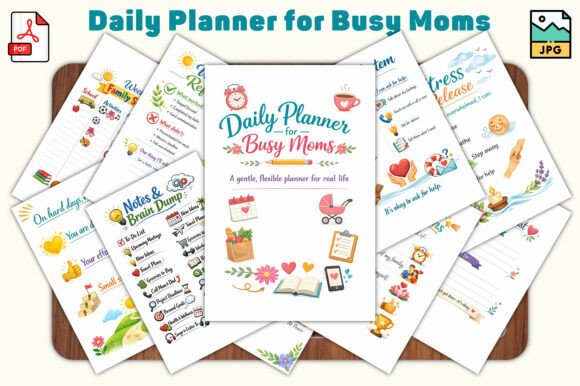
The 38 thoughtfully designed pages are not a collection of identical daily grids. Instead, they form a layered system that supports planning at multiple timescales:
- Welcome Mindset Pages – These set the tone. Rather than jumping straight into scheduling, the planner begins with gentle reminders about flexibility, self-compassion, and the idea that planning is a tool for grace, not perfection. This is especially valuable for moms who carry guilt about not doing enough.
- Monthly Planning Pages – Each month includes an overview spread, space for goal setting, family priorities, self-care intentions, and an end-of-month reflection. This high-level view helps you align your weekly actions with what truly matters over the longer term.
- Weekly and Daily Pages – The core of the planner, these pages offer flexible layouts for tasks, appointments, meal planning, water intake, exercise, mood tracking, and notes. Because life is unpredictable, there are no strict rules about how to fill them—you can use the spaces in whatever way serves you best.
- Specialized Sections – Additional pages cover routines, habit tracking, gratitude prompts, brainstorming spaces, and notes. These are designed to capture the non-negotiable elements of mom life that typical planners ignore.
The vertical 6×9″ format is intentional: it fits into most bags, stands easily on a counter or desk, and offers enough writing space without feeling overwhelming. The instant download means you can start using it immediately, printing only the pages you need at any given time.
Practical Implementation: Integrating the Planner into Your Routine
The real value of any planner lies in how naturally it integrates into your existing habits. Here are several ways to make the Daily Planner for Busy Moms a seamless part of your day without adding friction.
Start with a Weekly Review, Not a Daily Grind
Many moms make the mistake of trying to plan every hour of every day. This approach backfires when interruptions happen. Instead, use the monthly overview to identify your three to five priorities for the upcoming week. Transfer these to the weekly pages, then let the daily pages emerge from that foundation. This top-down approach reduces the pressure to micromanage each day and instead focuses on progress across the week.
Pair the Planner with a Digital Calendar
The planner does not need to replace your digital tools. Use a shared digital calendar (Google Calendar, Apple Calendar, or Outlook) for appointments, school events, and work meetings that involve other people. Then use the Daily Planner for Busy Moms for your personal tasks, priorities, self-care, and reflection. This division of labor ensures that time-sensitive events are handled electronically (with reminders), while your deeper planning and intention-setting happen on paper, where you can think without notifications.
Treat Self-Care as a Planning Category, Not an Afterthought
One of the planner's strongest features is that self-care intentions are built into the monthly and daily structures—not tacked on as an afterthought. When you fill out your monthly intentions, explicitly block time for rest, exercise, hobbies, or simply doing nothing. On the daily pages, check in with your mood and energy levels. Over time, this normalizes the idea that your well-being is a legitimate planning priority, on par with grocery shopping or work deadlines.
Use the Reflection Pages as a Feedback Loop
The end-of-month reflection is not busywork. It is a quality control mechanism for your planning system. Ask yourself: Did I prioritize what I actually value? Where did I spend time that didn't align with my intentions? What adjustments would make next month feel more manageable? This feedback loop turns the planner into a living tool that evolves with you, rather than a static template you outgrow.
Workflow Examples: The Planner in Action
To illustrate how the planner functions in different contexts, here are three realistic scenarios.
Scenario 1: The Work-from-Home Mom with School-Age Children. You have a freelance project due in two weeks and three kids with conflicting after-school activities. Start with the monthly overview: mark the project deadline, the activity days, and one self-care intention (e.g., a 20-minute walk three times a week). On the weekly spread, break the project into three milestones. Each morning, use the daily page to list the top three tasks for the day—one work-related, one family-related, and one personal. At the end of the week, note what worked and what felt chaotic. Adjust the following week accordingly.
Scenario 2: The Mom Launching a Small Business. You are developing a product line while managing a toddler's schedule. Use the monthly pages to set business milestones (e.g., finalize packaging, launch social media) alongside family priorities (e.g., pediatrician visits, playdates). The daily pages become a workspace for brainstorming, supplier calls, and time blocking. The gratitude and mood tracking pages help you stay grounded during stressful periods. The reflection pages let you evaluate whether your business goals are realistic given your family's current needs.
Scenario 3: The Mom Returning to a Creative Practice. Perhaps you are a writer, artist, or musician who has struggled to find time for your craft. Use the monthly overview to set a creative intention (e.g., complete one sketch per week). On the weekly pages, schedule a recurring "creative hour" as a non-negotiable appointment. The daily pages can include a small creative prompt or a note about inspiration you encountered. The self-care section reinforces that creative expression is part of your well-being, not a luxury you can postpone indefinitely.
Long-Term Use: Building a Planning Habit That Lasts
The true test of any planner is whether you still use it three months later. The Daily Planner for Busy Moms encourages longevity through its forgiving design. Because there are no rigid formats, you never "fall behind" in the way you might with a dated planner. If you skip a week, you simply pick up with the next page. If a layout does not suit your current season, you print a different page from the PDF files.
This flexibility is crucial for moms, whose availability and energy levels fluctuate. Some weeks demand intense daily planning; others require only a loose overview. The planner accommodates both without judgment.
Over months of use, a pattern emerges. You begin to recognize your recurring bottlenecks—the afternoons when everyone is tired, the days when your own energy dips, the tasks that consistently get postponed. With the reflection pages as a record, you can make structural changes to your routine, rather than just pushing harder through the same obstacles.
Practical Considerations: Format, Printing, and Compatibility
The digital nature of the planner adds significant flexibility. Because it arrives as both PDF and JPG files, you can print individual pages as needed, upload them to a note-taking app like GoodNotes or Notability, or keep a physical binder with only the pages you use. This reduces waste and allows you to customize the size and binding to your preference.
The vertical 6×9″ format is compatible with standard printer paper sizes when printed at full scale, and it fits neatly into A5 or personal-size binders. If you prefer a larger writing area, you can scale the pages up during printing. The instant download means you can start within minutes of purchase, which is ideal for a mom who needs a solution today, not next week.
For those who use digital planning tools, the JPG files can be imported into tablet-based planners. This hybrid approach—digital for portability and handwriting, physical for deeper focus—gives you the best of both worlds.
Why This Approach Matters for Moms Who Also Work, Create, or Lead
Moms are not a monolith. Many hold professional roles, run businesses, pursue creative projects, or volunteer in their communities. The Daily Planner for Busy Moms avoids the trap of assuming that a mother's only priorities are household maintenance and childcare. Instead, it creates space for all the identities a woman carries, while acknowledging that time and energy are finite.
From a process perspective, this planner acts as a decision filter. When you have multiple competing demands, the act of writing down priorities forces clarity. You cannot put everything on the page—and that limitation is the point. It trains you to choose, to protect your time, and to say no to what does not align with your current intentions.
For the entrepreneur mom, it replaces the chaos of multiple notebooks and app alerts with a single, coherent system. For the creative mom, it offers a container for ideas that might otherwise evaporate in the noise of daily life. For the mom who simply wants to feel less overwhelmed, it provides a structure that is more supportive than restrictive.
Ultimately, the value of the Daily Planner for Busy Moms is not in its pages but in the mental shift it enables: from reacting to every demand to proactively shaping your days around what matters. That shift, practiced consistently, transforms planning from a chore into a lifeline.