Fun with Vowels Blends: A Practical Look at Phonics Learning Tools
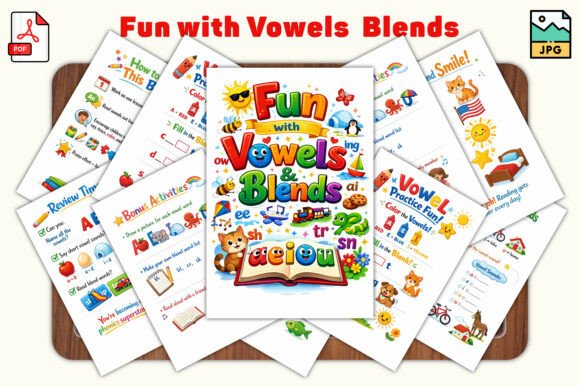
Building early reading skills is one of the most rewarding challenges for parents and educators. The leap from knowing individual letter sounds to blending them into words is a critical milestone, yet it is often where young learners encounter their first real frustration. Resources that promise to make this leap easier abound, but knowing which tool fits a specific teaching style or child's needs requires careful consideration. Fun with Vowels Blends is one such resource that positions itself at the intersection of playful engagement and systematic phonics practice. Instead of simply reviewing its features, this article explores how it compares to broader learning approaches, where it fits best, and what tradeoffs to consider before introducing it into your routine.
Targeted Mastery Versus Broad Curriculum Coverage
One of the most significant distinctions between Fun with Vowels Blends and a standard early reading workbook lies in its scope. Many comprehensive workbooks attempt to cover letter formation, sight words, reading comprehension, and phonics in a single volume. While this all-in-one approach seems convenient, it can sometimes overwhelm a child who is struggling specifically with vowel sounds or consonant blends.
Fun with Vowels Blends intentionally narrows its focus to two of the more challenging phonetic areas: short and long vowel sounds, and beginning plus ending consonant blends. This targeted approach is a distinct advantage when a child has already mastered basic letter recognition but needs repeated, structured practice to internalize the irregularities of vowels (consider the difference between "cap" and "cape") or the flow of blends like "st" or "nd."
The 14-page format reinforces this focus. Compared to a 300-page workbook that a child may never finish, this compact pack offers an achievable goal. Completing a focused set of activities builds a sense of accomplishment that fuels a child's willingness to tackle the next literacy challenge. If you are looking for a tool that drills down on a specific skill gap rather than broadly covering the entire language arts spectrum, this focused model is a strong contender.
Digital Delivery and the Flexibility Factor
Another critical comparison point is the format. Fun with Vowels Blends is delivered as a digital product, including a high-quality PDF and individual JPG pages. For anyone who has managed a classroom or a homeschool environment, this logistical advantage is significant. Traditional pre-printed workbooks are single-use, costly to replace, and require waiting for shipping. Digital delivery offers distinct practical benefits:
- Reproducibility: You can print the 6x9 inch pages for multiple children or reprint a specific page if a child needs extra practice on a particular blend.
- Flexible Use: The included JPG files can be uploaded into drawing apps on a tablet for a no-print, travel-friendly activity. This hybrid online-offline capability is something a physical workbook simply cannot offer.
- Cost-Effectiveness: For a parent with three young children, buying three separate workbooks for phonics practice can be expensive. A single digital download that can be printed for each child presents a more budget-conscious alternative without sacrificing the quality of the practice material.
The tradeoff, of course, is the need for a printer, paper, and perhaps a laminator for durability. While the setup is minimal, it is a factor compared to the grab-and-go convenience of a bound book. However, for educators and homeschoolers who already use printed materials, this format offers significantly more control over how the resource is used and reused.
Playful Structure Versus Gamified Learning
The literacy market includes highly gamified apps and online platforms designed to hook children with animations and rewards. While these can be effective, they also bring the challenges of screen-time management and potential distraction. Fun with Vowels Blends takes a different route, relying on a clean, child-friendly layout and a clear white background that minimizes visual noise.
This design choice is deliberate. The "playful" aspect comes not from flashy graphics, but from the manageable nature of the tasks. Simple word-building and pattern recognition activities allow a child to engage with the material without the cognitive load of decoding complex instructions or navigating a digital interface. For a child who becomes over-stimulated by noisy apps, this quieter, more structured approach to phonics can lead to better focus and deeper learning.
However, if a child is highly resistant to any form of worksheet or printed activity, a purely gamified app might be a necessary stepping stone to build initial engagement. In that scenario, Fun with Vowels Blends could serve as a transition tool once the child is ready for more focused, offline practice. It is a resource designed for the "working" part of learning, best used in short, purposeful sessions rather than passive entertainment.
Decision Factors: Environment, Stage, and Goals
To determine if this resource is right for you, consider the following scenarios where it performs particularly well, as well as situations where an alternative approach might be better.
Best-Fit Scenarios
- The "Bridge" Learner: A child who knows letter sounds confidently but struggles to blend them into words (e.g., reading "b-u-g" as separate sounds). The blend-specific focus directly targets this hurdle.
- The Confidence-Seeking Student: A young learner who feels defeated by large textbooks. The 14-page structure is non-intimidating and allows for a clear celebration of progress upon completion.
- The Busy Educator: A teacher setting up literacy centers who needs a quick, no-prep activity that reinforces the specific vowel or blend taught that week. The JPG format makes it easy to print for small groups or display on a smartboard.
- The Hands-On Homeschooler: A parent looking for a print-and-go supplement to their reading curriculum that can be adapted for multiple ages.
When Another Option Might Be Needed
- The Pre-Reader: If a child does not yet know most basic consonant sounds or cannot hear rhyming patterns (phonological awareness), they may need foundational oral language games before benefiting from a vowel and blend workbook.
- The Child Requiring Comprehensive Instruction: For a student with significant reading difficulties or dyslexia, a simple pack like this may not provide the systematic, multi-sensory, and cumulative instruction required. It is a practice tool, not a full intervention curriculum.
- When you need a full scope: If you are looking for a standalone curriculum that covers handwriting, vocabulary, and comprehension in one package, you would need to pair this resource with other materials to build a complete program.
Practical Considerations for Getting the Most Out of the Pack
Once you understand the fit, maximizing the resource is straightforward. Its simplicity is its superpower. Here are a few ways to extend its value:
- Go Durable: Print the pages on cardstock and slip them into sheet protectors or laminate them. This allows for repeated use with dry-erase markers, making the 14 pages last for years of practice or for multiple children.
- Go Multisensory: Instead of using a pencil, have the child build the words using magnetic letters or alphabet tiles directly on top of the printed page. This transforms a writing exercise into a kinesthetic word-building game.
- Go Digital: Use the individual JPG files on a tablet with a markup app (like Kami or Notability). This is an excellent option for car rides, waiting rooms, or days when printing is not feasible.
- Pacing is Key: Do not attempt to complete the entire pack in one sitting. One or two pages per day is sufficient to build skills without causing burnout. The goal is mastery and confidence, not speed.
Understanding the Scope: Depth Over Breadth
It is important to recognize what Fun with Vowels Blends is designed to be: a playful, focused, and reproducible phonics practice pack. It is not a complete learn-to-read system. Its strength lies in its targeted precision. By concentrating entirely on short and long vowel sounds and consonant blends, it provides the kind of deliberate practice that is essential for orthographic mapping—the process by which the brain stores written words for automatic retrieval.
Compared to generic phonics worksheets that mix skills arbitrarily, this pack offers a cohesive thread. The child is not jumping from counting syllables to circling pictures. They are consistently working on decoding and encoding words that follow predictable patterns involving vowels and blends. This consistency helps solidify the neural pathways needed for fluent reading.
For a parent or teacher who recognizes that a child is "stuck" on words like "clap," "stop," "cake," or "pet," having a dedicated resource that builds up from simple vowel patterns to more complex blends is highly practical. It fills a specific gap that many broader programs leave open.
Final Thoughts on Choosing the Right Phonics Resource
Selecting a learning resource is rarely about finding a single "best" option. Instead, it is about finding the right fit for a specific child, in a specific environment, at a specific stage of development. Fun with Vowels Blends excels as a supplementary tool that brings clarity and confidence to the often-messy process of learning vowel sounds and blends. Its compact size, child-friendly layout, and reproducible digital format make it a practical choice for parents and teachers who value efficiency and focus.
If you are exploring options for early literacy, evaluate where your learner's strengths and weaknesses lie. If they need foundational phonemic awareness or a full structured literacy curriculum, you will likely need a broader start. However, if they have the basic alphabet down and are ready to tackle the tricky world of vowels and blends with a resource that respects their capacity for focused work while keeping the pressure low, this pack represents a thoughtful and effective tool to add to your teaching toolkit. It turns a potentially tedious phonics drill into a satisfying, completable journey.