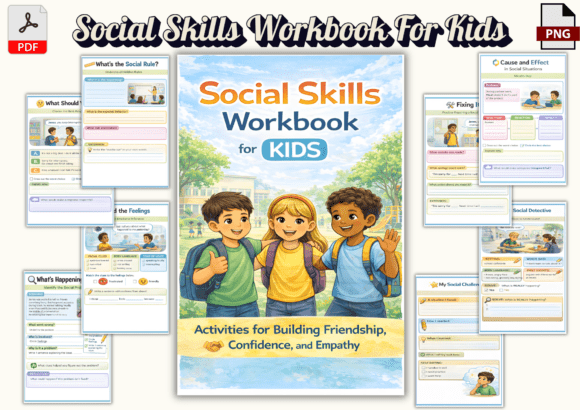
Social Skills Workbook for Kids: A Practical Tool for Building Social-Emotional Competence
Social-emotional learning has become a core priority in classrooms and homes alike, yet finding structured, ready-to-use resources that genuinely engage elementary learners can be challenging. The Social Skills Workbook for Kids addresses this gap with a focused 16-page printable toolkit designed for children in grades 2 through 6. Available as both PDF and PNG files in a compact 6x9 inch format, this resource offers a practical, no-prep solution for educators, therapists, and parents seeking to strengthen pragmatic language, emotional regulation, and interpersonal reasoning in young learners.
What distinguishes this workbook is not just its content breadth but its intentional structure. Each worksheet targets a specific social competency, from identifying social problems and practicing perspective taking to navigating group dynamics and repairing social mistakes. For professionals working within tight schedules or homeschooling parents managing multiple responsibilities, the print-friendly and digital-compatible format adds genuine logistical value.
What the Workbook Offers: Scope and Structure
The workbook contains 16 distinct worksheets, each built around a real-life social scenario or skill-building exercise. The content is organized to progress from foundational awareness to more complex interpersonal application. Topics include:
- Identifying the Social Problem – Exercises that help students recognize when a social situation requires a thoughtful response
- Perspective Taking Activities – Prompts encouraging children to consider how others might feel or think in a given scenario
- Emotional Inference Worksheets – Tasks that build the ability to read emotional cues from context and nonverbal signals
- Hidden Social Rules Practice – Lessons on unspoken expectations in common settings such as classrooms, lunchrooms, and group play
- Choose the Best Response Scenarios – Multiple-choice and open-ended dilemmas that teach decision-making in social contexts
- Cause and Effect Social Chains – Activities connecting actions to social outcomes, reinforcing accountability and foresight
- Repairing Social Mistakes – Guided steps for apologizing, making amends, and restoring trust after a misstep
- Flexible vs. Rigid Thinking – Worksheets that contrast adaptive problem-solving with fixed, inflexible responses
- Conversation Skills Practice – Structured prompts for turn-taking, asking questions, and staying on topic
- Big vs. Small Problem Scale – A visual tool for sizing up problems and matching reactions to the scale of the issue
- Social Detective Activity – Exercises in observing social cues and drawing reasonable inferences
- Friendship Skills Builder – Scenarios about initiating play, sharing, and managing disagreements
- Group Work Scenarios – Tasks that simulate collaborative decision-making and role negotiation
- Real-Life Reflection Page – A space for students to apply learned concepts to their own experiences
This breadth means the workbook can serve as either a stand-alone intervention or a supplement to a broader SEL curriculum. The 6x9 inch size is intentionally compact—smaller than a standard letter page but large enough for children to write or draw responses comfortably. This also makes it easy to slip into a binder, folder, or therapy bag for use across multiple settings.
Strengths and Practical Value for Professionals
For school counselors, speech-language pathologists, and special education teachers, time is a constant constraint. The Social Skills Workbook for Kids removes the need to design lessons from scratch. Each worksheet is ready to print and apply, and the digital PNG format allows for integration into tablets, smartboards, or teletherapy platforms. This flexibility is especially relevant for professionals serving students across different environments—some may prefer a printed packet, while others may want to project the worksheet during a group session and discuss answers collaboratively.
The workbook also supports differentiation. Several worksheets—such as the Big vs. Small Problem Scale and the Emotional Inference tasks—can be used with students at varying developmental levels by adjusting the depth of discussion or scaffolding the prompts. A second grader may use the perspective taking page with simple illustrations and verbal prompting, while a fifth grader might complete the same worksheet independently and then elaborate in writing. This range makes the resource suitable across a span of ages and abilities within the elementary bracket.
Another notable strength is the emphasis on cause-effect reasoning and social repair. Many social skills resources focus heavily on identifying feelings or following rules but stop short of teaching students how to recover from social errors. The Repairing Social Mistakes worksheet, combined with the Cause and Effect Social Chains, provides a structured pathway for students to understand consequences and practice restorative actions. For children who struggle with impulsivity or have experienced frequent social rejection, these sections can be particularly valuable.
Who Benefits Most and in What Settings
While the workbook is broadly designed for grades 2–6, certain audiences will find it especially useful:
- School-based counselors and SEL coordinators who need reproducible, low-prep materials for small groups or whole-class lessons. The worksheets can be used weekly as part of a tier-2 intervention for students with social skill deficits.
- Speech-language pathologists targeting pragmatic language goals. The Conversation Skills Practice and Social Detective Activity align well with goals around topic maintenance, perspective taking, and non-literal language.
- Homeschooling parents seeking structured social-emotional content that can be woven into morning meetings, literature discussions, or dedicated SEL time.
- Therapists and clinicians working with children diagnosed with autism spectrum disorder, ADHD, or social anxiety. The clear, visual format and consistent layout reduce cognitive load, allowing students to focus on the social reasoning task itself.
- Teachers in inclusive classrooms who need materials that support both neurotypical students and those with individualized education plans. The worksheets are straightforward enough for independent work but rich enough for guided discussion.
One realistic scenario: a school counselor uses the Hidden Social Rules Practice worksheet during a lunchtime social skills group for third graders. The group discusses why certain behaviors—like standing too close when talking or interrupting a conversation—can confuse or irritate peers. The worksheet provides a common vocabulary for discussing these invisible norms, and the counselor can follow up with role-play. Over several sessions, the workbook becomes a consistent reference point for the group.
Quality, Usability, and Effectiveness Considerations
The digital delivery means the end user controls formatting. Print quality depends on the printer and paper used, but the high-resolution PNG and PDF files ensure crisp text and clear layout when printed or displayed. The 6x9 inch trim size is intentional for portability and student engagement—smaller pages can feel less intimidating than a full letter-sized worksheet, especially for reluctant writers or younger children.
That said, there are practical limitations worth noting. The workbook is not a comprehensive curriculum; rather, it is a collection of worksheets that work best when facilitated by an adult who can guide discussion, model responses, and provide feedback. A child left to complete the pages entirely alone may miss the deeper social coaching that makes the exercises meaningful. For maximum effectiveness, educators and parents should plan to sit with the student during or after each worksheet, even briefly, to reinforce the concepts.
Additionally, the resource does not include explicit lesson plans, data tracking sheets, or progress monitoring tools. Professionals who need quantifiable benchmarks may want to supplement with their own observational notes or rubrics. The worksheets themselves, however, do lend themselves well to portfolio-style assessment—completed pages can be dated and reviewed over time to show growth in reasoning and self-awareness.
Durability in repeated use is another factor. Since the files are printable, a single purchase can be used across multiple students or years, making the cost per use very low for schools or clinics. The PNG format allows for easy import into apps like GoodNotes, Notability, or Kami for paperless use on devices with annotation tools.
Practical Recommendations for Getting the Most Out of the Workbook
To maximize the value of the Social Skills Workbook for Kids, consider these implementation approaches:
- Start with the self-reflection page. Before diving into specific skill areas, have the student complete the Real-Life Reflection Page. This provides a baseline snapshot of their current social challenges and goals, and it can be revisited at the end of the workbook to measure growth.
- Use the Big vs. Small Problem Scale as an anchor. This visual scale can be referenced across multiple sessions, not just during the designated worksheet. When a student overreacts to a minor frustration, a quick reminder to "check the scale" can reinforce the concept in real time.
- Pair the Flexible vs. Rigid Thinking worksheet with real-life examples. After completing the page, ask the student to think of a moment that day when they had to adjust their expectations. This bridges the worksheet to lived experience and strengthens generalization.
- Incorporate the worksheets into a weekly routine. Consistency matters more than volume. One worksheet per week, with a follow-up conversation, will likely yield better long-term results than rushing through all 16 pages in a few days.
- Combine with role-play and video modeling. The scenarios on the "Choose the Best Response" and "Group Work Scenarios" pages are ideal springboards for acting out alternatives. Recording short video clips of the student demonstrating the appropriate response can be a powerful confidence booster and learning tool.
Who Might Look for an Alternative Resource
While the workbook serves many needs well, it may not be the best fit for every situation. Professionals who require a full, scripted curriculum with daily lesson plans and standardized assessments will need to pair this resource with a more comprehensive program. Similarly, parents of children with severe language delays or very young preschoolers (below age 7) may find the written format too advanced—though the concepts can be adapted with heavy adult scaffolding and verbal delivery. The workbook assumes a basic ability to read and write short responses, which may not align with every learner's current skill profile.
Additionally, the workbook focuses entirely on social scenarios without addressing emotional regulation in a sensory or physiological sense. Students who need foundational self-regulation tools—such as breathing techniques or sensory breaks—may benefit from using this workbook alongside a dedicated regulation curriculum rather than as a replacement for one.
Final Assessment
The Social Skills Workbook for Kids fills a specific niche well: it is a focused, reproducible, and thoughtfully sequenced set of 16 worksheets that target essential social competencies for elementary-aged learners. Its strength lies not in novelty but in clarity and practicality. For professionals and parents who need reliable, ready-to-use content that can be adapted to individual needs and settings, this resource delivers consistent value. The compact size, dual format availability, and emphasis on both reasoning and repair make it a useful addition to any SEL toolkit. When facilitated by an engaged adult, the workbook can help students move from simply identifying social rules to genuinely understanding the perspectives and feelings of others—a shift that lies at the heart of lasting social growth.