1000 AI Instruction Design Guide
Why Precision in AI Communication Matters More Than Ever
Every conversation you have with an AI tool begins with an instruction. That instruction—whether it is a short sentence or a detailed paragraph—determines everything that follows. Vague prompts produce generic results. Precise instructions unlock focused, high-quality outputs that save time and reduce frustration. The 1000 AI Instruction Design Guide is built around this simple truth. It is not a collection of random prompts. It is a structured system that helps you think clearly about what you want from AI and how to express it in a way the machine can execute reliably.
This guide matters because AI tools are only as useful as the instructions they receive. When you learn to design instructions with intention, you stop hoping for good results and start generating them consistently. The product offers 1000 practical instruction prompts, each one grounded in proven frameworks that emphasize clarity, audience awareness, and modular structure. Whether you are drafting marketing copy, writing a lesson plan, or generating creative concepts, these prompts help you move from vague ideas to actionable requests.
What Makes the Guide Different from Ordinary Prompt Collections
Many prompt lists simply give you questions to copy and paste. This guide does something more valuable. It teaches you the architecture behind great instructions. The frameworks included in the planner are designed to be reused and adapted across projects. You are not learning one-off tricks. You are learning a repeatable method for communicating with AI.
The guide emphasizes clarity-first design principles. Every prompt is structured so that the AI understands the context, the task, the format, and the audience before it generates a single word. This reduces the need for multiple revisions and makes your workflow faster. The audience intent mapping feature helps you tailor instructions for different users—whether you are writing for beginners, experts, or a mixed audience. You can specify tone, complexity, and purpose with precision.
The layout itself is modular and scannable. You do not need to read the guide cover to cover. You can jump to the section that matches your current task, find a relevant framework, and apply it immediately. This makes it suitable for busy professionals who need results without unnecessary overhead.
Content Creators and Marketers
If you create content regularly, you know how quickly prompt fatigue sets in. Writing the same types of instructions over and over leads to stale outputs. The 1000 prompts in this guide cover formats like blog posts, social media captions, email sequences, product descriptions, and ad copy. More importantly, they show you how to vary structure and tone so that each output feels fresh. For example, you can use one framework to generate a punchy Instagram caption and a different framework to produce a detailed LinkedIn article—both from the same core idea.
Marketers will appreciate the audience intent mapping feature. You can design instructions that align with different stages of the customer journey: awareness, consideration, decision. This turns your AI tool into a strategic partner rather than just a content generator.
Designers and Creative Professionals
Designers often use AI for brainstorming, mood board descriptions, or copy for design presentations. The modular prompts help you request specific visual styles, color palettes, or conceptual directions. Instead of saying "make it look modern," you can say "describe a layout that uses a monochromatic color scheme with sans-serif typography and ample white space, targeting a professional audience aged 30 to 45." The guide gives you the language to be specific without being verbose.
Entrepreneurs and Small Business Owners
When you run a business, every minute counts. You cannot afford to waste time tweaking prompts that almost work. The structured frameworks in this guide help you draft instructions for customer service scripts, FAQ responses, proposal drafts, and internal documentation. You can build a library of repeatable prompts that your team can use without additional training. Consistency across your brand communication becomes easier to maintain.
Educators and Trainers
Teachers and course creators can use the guide to design instructions that generate learning materials, quiz questions, discussion prompts, and simplified explanations. The clarity-first principles ensure that the AI produces content that matches the reading level and learning objectives of your students. You can adapt the same framework for different age groups or subject areas by adjusting the audience parameters.
Practical Ways to Adapt the Guide for Your Workflow
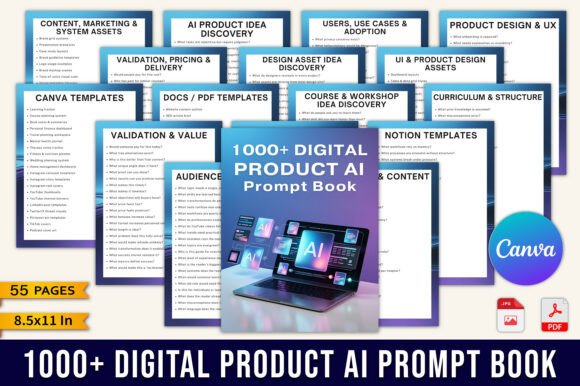
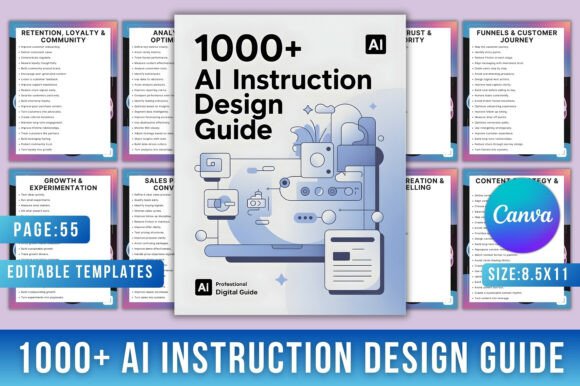
The guide comes as a set of 55 editable Canva pages and a high-quality PDF ready to upload. You can customize the prompts to fit your specific tools, whether you use ChatGPT, Claude, Gemini, or another platform. The modular layout means you can reorganize sections, add your own notes, or combine prompts from different frameworks to create hybrid instructions.
One effective approach is to start with the audience intent mapping before you even write a prompt. Identify who will consume the AI output and what action you want them to take. Then select a framework that matches that goal. This sequence alone eliminates most of the guesswork that leads to weak results.
Another adaptation is to use the prompts as templates for recurring tasks. If you generate weekly social media content, save a set of prompts with your brand voice already embedded. Each week, you only need to update the topic or reference material. This turns a weekly 30-minute prompt-writing session into a five-minute task.
Realistic Examples of Instruction Design in Action
Imagine you are writing a product description for a handmade ceramic mug. A vague prompt might be: "Write a product description for a mug." The output will be generic and forgettable.
Using the guide, you would first identify your audience: design-conscious buyers aged 25 to 40 who value craftsmanship. You would set the intent: inspire an emotional connection and highlight durability. You would then use a structured framework that includes context, task, format, and tone. Your prompt might look like:
"Write a product description for a handmade ceramic mug. The mug is stoneware, glazed in a matte navy finish, and holds 12 ounces. Target audience: adults aged 25–40 who appreciate artisan goods and minimal design. Tone: warm but not sentimental. Format: three short paragraphs with a headline and a bullet list of features. Emphasize the weight, texture, and durability."
The output will read like something a small brand would publish, not a generic template. The difference comes from the instruction design, not from luck.
Keeping Results Clear, Organized, and Consistent
Consistency is one of the hardest things to achieve with AI because small changes in wording can produce wildly different outputs. The guide addresses this by giving you repeatable frameworks that anchor your instructions in the same structure every time. Once you find a framework that works for a specific type of task, you can reuse it with confidence.
To keep outputs clear, always include the following in your instructions: context (what the situation is), task (what you want the AI to do), format (how the output should look), and audience (who will read it). The guide reinforces these four elements across all 1000 prompts.
To stay organized, use the modular layout to group prompts by project or role. If you are a freelancer managing multiple clients, create a section for each client with their specific tone and style notes. The editable Canva format makes this easy to update as your needs change.
Who Can Benefit Most from This Resource
This guide is designed for adults aged 20 to 50 who work with AI regularly or want to start. It suits creators, designers, marketers, bloggers, entrepreneurs, educators, hobbyists, freelancers, publishers, and small business owners. If you have ever felt frustrated by AI outputs that miss the mark, this guide gives you a systematic way to fix the problem at the source: the instruction itself.
The 55 pages are dense with practical material, but the scannable layout means you do not need to be an expert to get value. Beginners can start with the basic frameworks and build confidence. Experienced users can dive into the advanced mapping techniques and fine-tune their existing workflows.
Final Recommendations for Getting the Most Out of the Guide
Treat the guide as a working document, not a static reference. Open the Canva link and make it your own. Add your own examples, delete what does not apply, and rearrange sections to match your priorities. The more you interact with the material, the more natural the instruction design process becomes.
Use the prompts as starting points, not final scripts. The best instructions are the ones you adapt to your specific context. The guide gives you the scaffolding; you bring the subject matter expertise.
Finally, pay attention to the clarity-first design principles even outside the guide. Once you internalize the four-element structure—context, task, format, audience—you will start using it in every AI interaction. That alone will improve your results more than any single prompt ever could. The 1000 AI Instruction Design Guide is not just a product. It is a skill-building tool that changes how you think about communication with AI.