The Tiny Dragon’s First Flight Story: A Gentle Tale of Courage and Self-Belief
When searching for children’s picture books that nurture emotional growth, many adults find themselves weighing subtle differences in tone, pacing, and message. The Tiny Dragon’s First Flight Story enters a well-loved category—books about overcoming fear and learning to try again. Yet it does so with a quiet, deliberate approach that sets it apart from more action-driven or directly moralizing alternatives. This article explores what makes this story distinct, how it compares with other common styles of children’s books, and how to decide if it is the right fit for your child or classroom.
What Makes The Tiny Dragon’s First Flight Story Distinct?
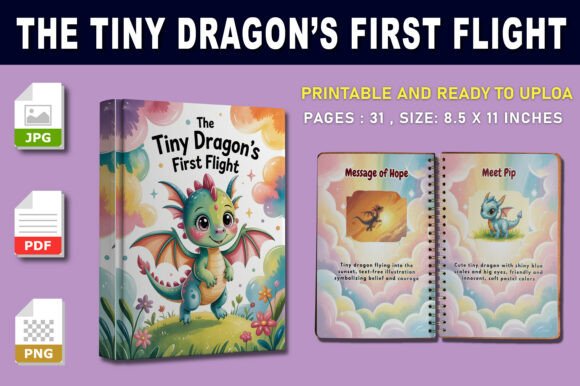
At its heart, The Tiny Dragon’s First Flight Story follows Pip, a small blue dragon who cannot yet fly like the others. The narrative unfolds not through dramatic rescues or sudden breakthroughs, but through small hops, soft falls, and patient practice. The key distinction lies in the story’s emotional pacing. Where many children’s books resolve a challenge in a single page turn or through a quick pep talk, this story lingers on the experience of repeated failure and the slow building of confidence.
The wise old turtle, Taro, does not offer a magical solution. Instead, Taro’s gentle words simply validate Pip’s effort and remind him that growth takes time. This modeling of patience and encouragement is a deliberate contrast to narratives that rely on instant transformation or external rewards. For an adult evaluating books for a 4–8 year old, this difference matters: a child who struggles with frustration may benefit more from a story that mirrors the gradual process of skill-building rather than one that jumps to success.
Comparing Approaches: Fast-paced vs. Slow-paced Storytelling
Most children’s picture books about perseverance fall into one of two patterns. The first is the fast-paced resilience story, where a character fails once, receives a quick tip, and then succeeds triumphantly. These stories are energetic and memorable, but they can unintentionally gloss over the emotional weight of repeated failure. The second pattern—slower, more reflective stories—gives space for the reader to sit with feelings of doubt and disappointment. The Tiny Dragon’s First Flight Story clearly belongs to the second category.
Consider a typical dragon-themed book where the protagonist masters flight in one brave leap. That narrative can be exhilarating, but it may leave a child who needs many tries feeling that something is wrong with them. In contrast, Pip’s journey shows that falling is part of the process. The story does not rush past the sadness Pip feels when he cannot keep up with other dragons. This honesty can be reassuring for children who are working on a skill—whether riding a bike, reading, or making friends—and who need to hear that small steps matter.
For an adult comparing options, the tradeoff is this: a fast-paced book may capture attention quickly and deliver a punchy message, while a slower book like The Tiny Dragon’s First Flight Story offers deeper emotional resonance and repeated comfort. The latter often works better for bedtime reading, where a soothing tone is valued, or for children who are prone to self-criticism.
Strengths of The Tiny Dragon’s First Flight Story
One of the strongest elements is the character of Taro. In many children’s stories, the wise mentor figure disappears after a single piece of advice. Here, Taro’s encouragement is woven throughout the narrative, reinforcing the message without becoming preachy. This sustained support models how real adults—parents, teachers, older siblings—can gently guide a child without solving the problem for them.
The soft pastel illustrations mentioned in the book’s description also play a critical role. Visuals in children’s books influence how a story feels. Bright, busy illustrations can energize a reader, but softer palettes create a calm, safe environment for discussing difficult emotions. For a child who is anxious about trying new things, the visual tone of the book can be as important as the words. A parent selecting a resource for a sensitive child might find that the quiet aesthetic of this book reduces the sense of pressure.
Another strength is the growth mindset framing. The story explicitly communicates that ability develops through practice, not innate talent. This is not a new idea in children’s literature, but many books deliver it through a character who simply “keeps trying” without acknowledging the emotional dips. The Tiny Dragon’s First Flight Story shows the dip: Pip feels sad and unsure, and that is portrayed as normal. This honest depiction can help children normalize their own frustrated feelings, which is a key step in building resilience.
Tradeoffs and Limitations to Consider
No single book can meet every need, and it is helpful to consider where The Tiny Dragon’s First Flight Story may not be the best fit.
The slow pacing, while a strength for some readers, may feel too gentle for children who thrive on high-energy plots. A child who loves comic-style action or who has a very short attention span might lose interest before the payoff. In such cases, alternating this book with a more dynamic story could be a good solution, using each to address different moods or learning goals.
The lack of direct dialogue about specific fears is another potential limitation. Pip’s struggle is generalized as difficulty flying. Some children may need a story that names a specific fear—like fear of falling, fear of judgment, or fear of the unknown. If a child is afraid of a particular situation (e.g., speaking in front of class), a story that directly addresses that scenario may feel more relevant. However, the open-ended nature of Pip’s challenge also allows children to project their own experiences onto the narrative, which can be a powerful tool for emotional processing.
Additionally, the wise turtle archetype, while warm, is a familiar trope in children’s books. Some adults may be looking for a story with a less predictable guidance structure—perhaps one where the protagonist learns through experience alone, or where peer support is highlighted instead of an elder mentor. If variety in narrative structure is a priority, this story fits a classic mold rather than breaking new ground.
Best-Fit Situations for The Tiny Dragon’s First Flight Story
Based on its tone and structure, this book is especially well-suited for several scenarios:
- Bedtime reading – The soft illustrations and gentle conflict make it a calming wind-down choice. It does not end with an adrenaline-fueled success, but with quiet joy.
- Children who are perfectionists – If a child avoids trying because they fear failure, Pip’s repeated falls and eventual success can normalize mistakes as part of learning.
- Classroom discussions about perseverance – Teachers can use the story to prompt conversations about how different people learn at different speeds, and how to support a friend who is struggling.
- Gifts for parents of young children – The book itself acts as a tool for parents to talk about patience and encouragement, offering a gentle model for how to respond when a child is frustrated.
On the other hand, if the goal is to teach a very specific skill or to address a particular behavioral issue (like giving up after one try), a more directive book with step-by-step strategies might be more effective.
How It Compares with Thematic Alternatives
When evaluating The Tiny Dragon’s First Flight Story against other books in the courage-and-flying category, the key differences often come down to emotional depth versus action and explicit versus implicit messaging.
Many popular dragon stories emphasize spectacle—breathing fire, soaring over mountains, battling obstacles. These can be thrilling, but they typically place the external challenge at the center. Pip’s challenge is internal: self-doubt and impatience. That inward focus makes this book a useful counterpart to more adventure-driven tales. If a child enjoys both, reading them together can provide a balanced emotional and imaginative experience.
In terms of implicit messaging, this story leans heavily on showing rather than telling. The moral is not stated in bold letters on the last page. Instead, the reader feels Pip’s small triumph because they have walked through his struggles. Books that clearly state “It’s okay to try again” can be helpful for direct instruction, but some children respond better to stories where the lesson is absorbed through empathy. The Tiny Dragon’s First Flight Story excels at this subtle, felt learning.
Decision Factors for Parents and Educators
As you compare options, consider these questions:
- What is the child’s current emotional need? If they are already confident but need a reminder to be patient, this book works well. If they need a loud, motivating cheer, a different style may be better.
- How does the child respond to gentle stories? Some children gravitate toward quiet narratives; others need more action to stay engaged. Know your reader’s preference.
- What is your role as the reader? If you are reading aloud at bedtime, the soothing rhythm of this story is ideal. If you are using the book in a group setting with active discussion, you may want to supplement it with questions or activities.
- Are you looking for diversity in representation? While dragons and turtles are universal, the human absence is notable. Some children benefit from stories with clear human characters or diverse cultural settings. If that is a priority, this fantastical approach may or may not fit your needs.
Final Thoughts on Making an Informed Choice
The Tiny Dragon’s First Flight Story occupies a valuable niche in the landscape of children’s picture books. It prioritizes emotional authenticity over spectacle, patience over quick fixes, and quiet support over loud encouragement. For many families and classrooms, these qualities make it a standout resource for teaching courage, perseverance, and self-belief in a way that feels safe and relatable.
Yet it is not a universal solution. The best approach is to view it as one tool among many—a complement to more active stories, a counterbalance to high-pressure messages, and a gentle touchstone for children who need to hear that learning takes time. By understanding its strengths and limitations, you can decide with confidence whether Pip’s small hops and eventual flight will resonate with the child you have in mind.